
How India Became a Global Hub for Trailer Brake Exports
Trailer brakes don’t get much glamour. Nobody writes poems about anchor pins or adjuster screws. But ask anyone who tows 20 tons down a wet downhill slope – they’ll tell you brakes are the difference between “smooth delivery” and “insurance paperwork.”
And quietly, consistently and with surprising precision, India has become one of the world’s most reliable sources of high-quality trailer brake components. Today, trailer brakes exporters India suppliers are shipping to the U.S., Europe, the Middle East, Africa and South America – and setting new standards while doing it.
How did this happen? Let’s break open the drum (spun intended).
 < >
< >
1. The Rise of India’s Trailer Brake Industry
India’s auto-component ecosystem didn’t become global overnight. It evolved.
Year after year, Indian manufacturers invested in:
- Better steel
- Robotic welding
- Powder coating
- CNC machining
- International certifications (ISO, IATF, SAE, FMVSS)
What started as a domestic supply chain is now an export engine powering fleets across continents.
2. What Trailer Brakes Actually Include
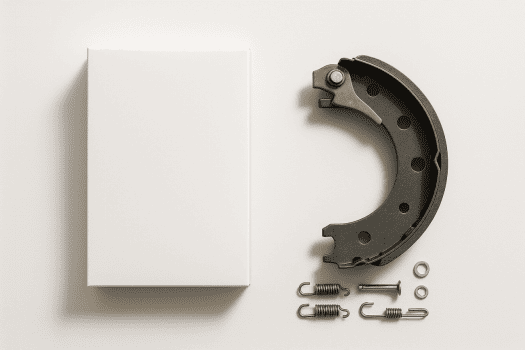
Trailer brake systems are not just brake shoes. They are a system – a mini engineering ecosystem.
Here’s a breakdown:
| Component | Function |
|---|---|
| Brake Shoes | Apply friction to stop the trailer |
| Lining | Heat-resistant surface for braking |
| Hardware Springs | Return / hold-down functions |
| Knurled Rollers | Smooth shoe movement |
| Anchor Pins | Pivot point for shoe actuation |
| Drums | Provide the surface for braking |
| Magnets (Electric Brake Systems) | Control actuation in electric braking |
3. Why Global Buyers Prefer Indian Exporters
India has risen to the top of the trailer brake export market for a few key reasons:
a. Consistent OE-Level Engineering
Indian suppliers now design with:
- CNC accuracy
- Automated welding
- Tight dimensional tolerances
- Heat-resistant materials
b. Affordability Without Lowering Quality
India’s advantage is the ability to deliver OE-grade quality at competitive pricing.
c. Export-Ready Manufacturing
Plants comply with:
- ISO 9001:2015
- IATF 16949:2016
- SAE and FMVSS requirements (critical for U.S. and EU markets)
d. Strong Logistics Networks
Port access, consolidated freight options and predictable lead times matter – India offers all three.
e. Ability to Customize for Regional Needs
A U.S. trailer brake kit is not the same as a Middle Eastern kit.
India adapts.
4. Typical Export Specs by Region
Here’s a realistic breakdown of what different markets expect:
| Region | Common Requirement | Notes |
|---|---|---|
| U.S. | FMVSS compliance, powder-coated shoes, electric magnets | High heat-resistance needed |
| EU | Tight dimensional tolerances, advanced coatings | Low noise + smooth actuation preferred |
| Middle East | High-temperature linings, corrosion-proof hardware | Survives desert heat + salt air |
| Africa | Rugged, high-wear hardware, strong anchor pins | Fewer service centers → need longevity |
| South America | Cost-efficiency + durability | High-volume fleets choose Indian kits |
Expert’s comment:
“Exporting brakes is not about sending metal abroad. It’s about sending reliability across climates.”
5. Compliance, Testing & Quality – The Real Differentiator
Before a kit ever makes its way into a shipping container, it must pass the following tests:
- Salt Spray Test
- Cyclic Fatigue
- Riveting Strength
- Heat Fade Simulation
- Dimensional Scan
- Lining Wear
These tests are not “good to have” … they’re non-negotiable.
6. The Value Indian Exporters Add Beyond Manufacturing
Top-tier Indian trailer brake exporters offer:
- Custom packaging
- Private label branding
- SKU-level batch tracking
- Ready-to-market kits
- Complete documentation + compliance files
- Supply chain planning
Many even support distributors with catalogue creation and part-number mapping.
Expert’s comment:
“Good manufacturers sell products. Great manufacturers help you sell them.”
7. Why Trailer Brakes Will Only Get Bigger for Indian Exporters
Three global trends are helping India scale further:
1. Growth in Logistics & Towing Vehicles
More cargo = more trailers = more brakes needed.
2. Rising Demand for Heavy-Duty Parts
The world is moving more goods on wheels than ever before.
3. Trust in Indian Engineering
Consistency wins the long race – and India has been consistent.
Final Thoughts
India’s position as a global leader in trailer brake exports didn’t happen by chance. It came from years of refining processes, upgrading technology and understanding global fleet behaviour better than ever.
For distributors, OEMs and private-label brands, partnering with a proven trailer brakes exporters India manufacturer means:
- Reliable quality
- Strong durability
- Smooth logistics
- Better margins
- Lower risk
And most importantly – peace of mind on every mile.

Copyright © 2026 Resilient All rights reserved. Designed By Royalways
